
Divorce in Texas: Your Complete Guide to the Process, Property, and What Comes Next
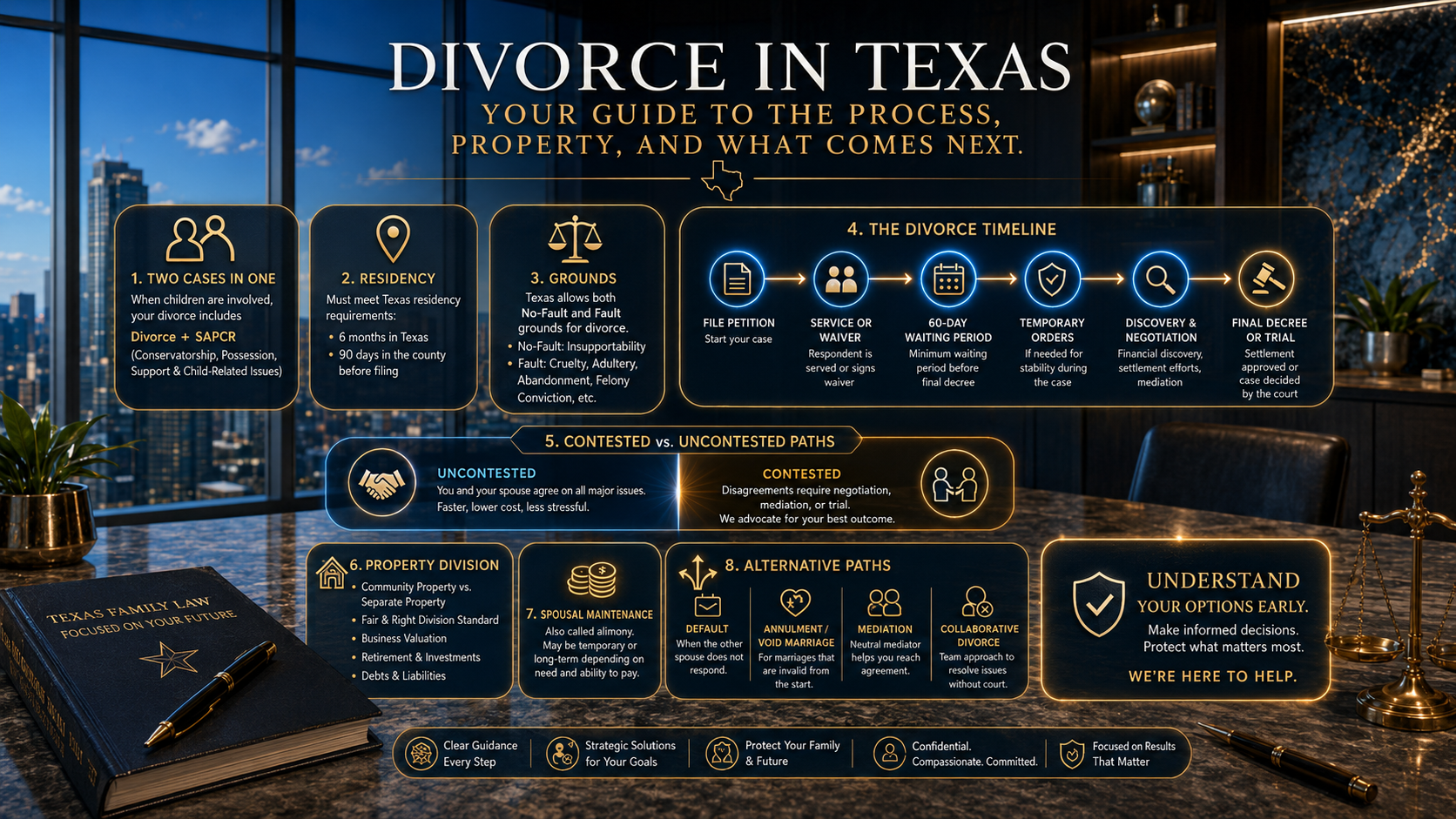
Divorce in Texas follows a defined legal path, but no two divorces travel it the same way. Yours might be resolved in a few months by agreement, or contested across a year of hearings. It might involve nothing but splitting a bank account and a house, or it might require valuing a business, tracing separate property, and litigating spousal maintenance. This page is the map. It walks through how divorce works in Texas, what the major decision points are, and where to go deep on each one.
Divorce with children is two cases in one
In Texas, a divorce involving children is legally a divorce combined with a suit affecting the parent-child relationship (SAPCR). Everything about conservatorship, possession, and child support is covered in our Child Custody hub; this hub covers the divorce itself.
Divorce and Children: Two Proceedings in One Case
Before going further, an important structural point. When a divorcing couple has children, Texas law treats the case as two things bundled together: the dissolution of the marriage, and a suit affecting the parent-child relationship. The divorce portion ends the marriage and divides the marital estate. The SAPCR portion decides conservatorship (what most people call custody), possession and access (visitation), and child support.
Because the child-related issues are their own body of law — and because they also arise outside divorce, for unmarried parents and in paternity and modification suits — we cover them in a dedicated hub. If your divorce involves children, read this hub for the divorce mechanics and the Child Custody, Conservatorship, Visitation, and Support hub for everything concerning the kids.
Do You Qualify to File in Texas?
Texas imposes residency requirements before you can file here: a durational requirement for the state and for the county where you file. Meeting them is the threshold question, and getting it wrong can delay your case. The details are in residency and filing requirements.
On What Grounds?
Texas is primarily a no-fault state — you can divorce on the ground that the marriage has become insupportable, without proving wrongdoing. But Texas also retains fault grounds such as cruelty, adultery, and abandonment, and pleading fault can matter to the division of property and other issues. Which path fits your situation is covered in grounds for divorce.
How Long Does It Take, and What Are the Steps?
Every Texas divorce runs through a sequence: petition, service or waiver, a statutory waiting period, temporary arrangements if needed, discovery and negotiation, and finally a decree by agreement or after trial. Texas also imposes a mandatory waiting period before a divorce can be finalized. The full sequence and realistic timelines are in the divorce process and timeline.
Contested or Uncontested?
If you and your spouse agree on everything, an uncontested divorce is faster and cheaper. If you disagree on property, support, or the children, the case is contested and follows a more involved path. Most cases fall somewhere between and settle before trial. Understanding the difference helps you set expectations and strategy.
Stability While the Case Is Pending
A divorce can take months, and life does not pause in the meantime. Temporary orders establish the rules for the interim — who lives where, who pays what, how bills and, if applicable, children are handled — until the final decree. For business owners, there is a specialized version of this in the business operations context.
Dividing What You Own
Texas is a community property state, and the court divides the community estate in a manner that is just and right, which is not always equal. Characterizing property as separate or community, valuing it, and dividing it is the financial heart of most divorces. Start with the property division overview. If significant assets or a business are involved, the business owner’s divorce hub goes deeper.
Support Between Spouses
Texas law allows for spousal maintenance in defined circumstances, with eligibility rules and caps that are stricter than in many states. Whether you may owe it or receive it, and how much, is covered in spousal maintenance and alimony.
When the Path Is Not Standard
Not every case fits the usual mold. If a spouse cannot be located or refuses to participate, a default divorce may be the route. If the marriage itself was legally defective, annulment or a void-marriage proceeding may apply instead of divorce. And many couples prefer to avoid the courtroom altogether through mediation or collaborative divorce.
Where to Begin
If you are just starting, read the grounds, process, and property-division pages first; they orient you to the whole. If a specific issue is pressing — a spouse who has emptied an account, a looming move, children caught in the middle — go straight to the page that addresses it, or speak with an attorney who can triage your situation. Every linked page ends where this one does: with the option to talk to someone who handles these cases every day.
Divorce in Texas – Related Pages
Arbitration in Texas Family Law
Discovery Masters in Texas Family Law
The Master-as-Mediator Hybrid in Texas Family Law
Special Masters and Masters in Chancery in Texas (Rule 171)
Private Judges and Special Judges in Texas (Chapter 151)
Mediation and Mediated Settlement Agreements in Texas
Informal and Rule 11 Settlement Agreements in Texas
Resolving Your Texas Family Law Case Out of Court
Authorization Agreements for Nonparent Relatives in Texas (Chapter 34)
Enforceability and How Texas Marital Agreements Are Challenged
Thinking about divorce, or just served with papers?
The earlier you understand your options, the better your decisions. Talk with a Texas family law attorney who handles these cases every day.
This page provides general information about Texas law and is not legal advice for your specific situation. Reading it does not create an attorney-client relationship.