
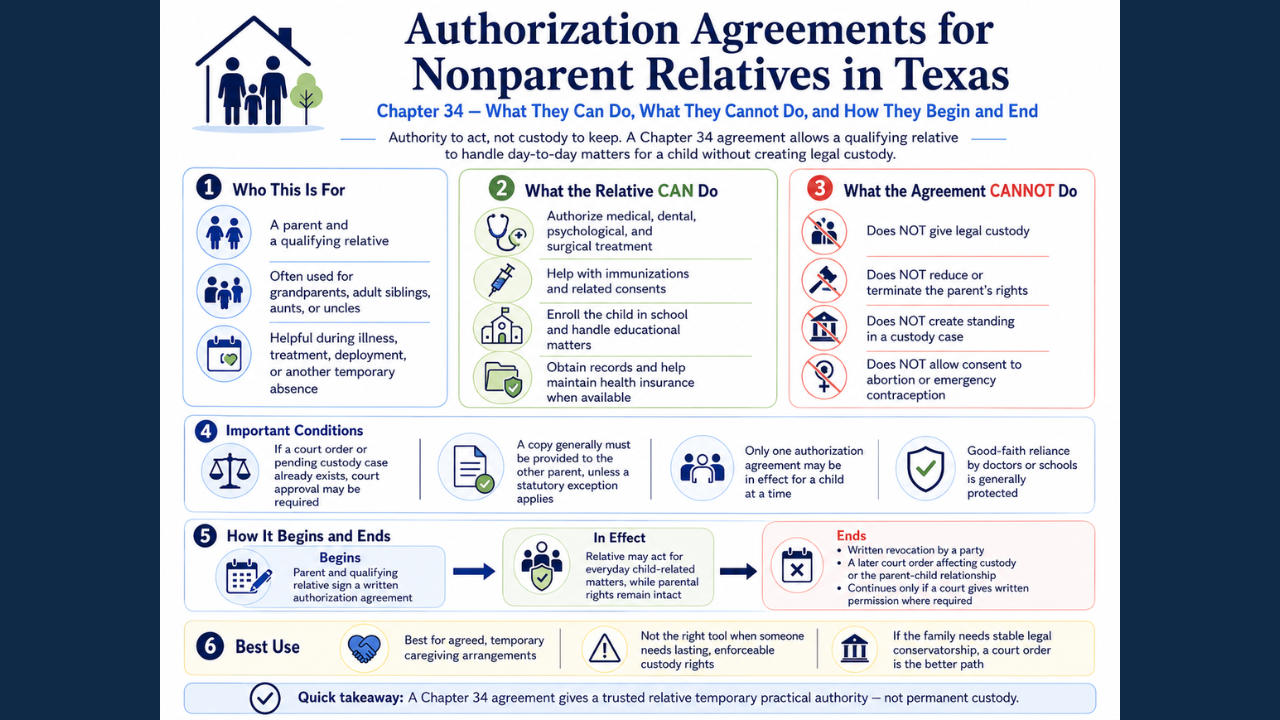
Authorization Agreements for Nonparent Relatives in Texas (Chapter 34)
Sometimes a child needs to live with a grandparent, an aunt or uncle, or an adult sibling for a while, during a parent’s deployment, illness, treatment, or other absence, and that relative needs to handle everyday matters: a doctor’s visit, a school enrollment, a prescription. Going to court for a custody order is not always necessary or appropriate for a temporary arrangement everyone agrees to. Chapter 34 of the Texas Family Code provides a lighter-weight tool for exactly this situation: the authorization agreement for a nonparent relative. This page explains what it is, what it can and cannot do, and how it fits alongside the custody options that do require a court.
Authority to act, not custody to keep
A Chapter 34 authorization agreement lets a relative make day-to-day decisions for a child without a court case. It does not give legal custody, does not reduce the parent’s rights, and does not create standing in a custody suit.
What a Chapter 34 Authorization Agreement Is
Chapter 34 of the Texas Family Code lets a parent enter into a written authorization agreement with a qualifying nonparent relative, giving that relative authority to perform specific acts for the child. The point is practical: it allows a trusted relative who is caring for a child to handle the ordinary decisions that caregiving requires, without the parent and relative having to open a court case to do it. The agreement operates by the parent’s consent, and it leaves the parent’s underlying rights intact.
Who Can Be a Party
The chapter applies to an agreement between a parent and a relative of the child within the relationships it specifies in Section 34.001. In practical terms, the qualifying relatives commonly include:
- The child’s grandparent.
- The child’s adult brother or sister.
- The child’s adult aunt or uncle.
The Texas Department of Family and Protective Services publishes a form for these relative agreements, though using the agency form is not mandatory so long as the agreement meets Chapter 34’s requirements. The chapter also addresses certain other voluntary caregiver and child-safety-placement situations, so if the caregiver is not one of the listed relatives, the right path may be different and worth confirming with counsel.
What the Relative Can Be Authorized to Do
Within the bounds of the statute, a parent can authorize the relative to handle the kinds of decisions that come up when you are responsible for a child’s daily life, including:
- Authorizing medical, dental, psychological, or surgical treatment and immunization, including the related consents and releases of information.
- Obtaining and maintaining health insurance coverage for the child where possible.
- Enrolling the child in school and addressing related educational decisions.
- Obtaining copies of the child’s identifying documents, such as a birth certificate, and other records, to the extent allowed by law.
There are express limits even within this authority. An authorization agreement does not give a relative the right to consent to an abortion for the child or the administration of emergency contraception, and where another law sets eligibility requirements for a service apart from parental consent, that other law controls. Notably, a Chapter 34 agreement is not required simply to enroll a child in public school, since other Education Code provisions can already allow enrollment in some living situations.
What It Does Not Do
This is the most important section to understand, because the agreement is easy to over-read. By statute, an authorization agreement does not affect the rights of the child’s parent or legal guardian regarding the care, custody, and control of the child, and it does not mean the relative has legal custody. It also does not confer or affect standing, or a right to intervene, in a Title 5 suit affecting the parent-child relationship. In other words, signing one does not give the relative custody, does not diminish the parent’s authority, and does not create a foothold to bring or join a custody case. A person who relies in good faith on a completed agreement, such as a doctor or school, is given protection from liability for that reliance, which is much of what makes the tool useful in practice.
If what a family actually needs is enforceable, lasting decision-making authority, that is a matter of conservatorship and requires a court order, not an authorization agreement. And if a relative is seeking to obtain custody rights over a parent’s objection, the relevant question is grandparent and nonparent standing to file a suit, which Chapter 34 specifically does not provide.
Court Permission, Notice, and Other Conditions
Chapter 34 builds in safeguards. Among the conditions that matter most in practice:
- Existing court orders or pending suits. If there is already a court order or pending litigation affecting the parent-child relationship or concerning custody, possession, or placement of the child, the agreement generally cannot be used unless the court with continuing jurisdiction has given written approval, a copy of which accompanies the agreement.
- Notice to the other parent. The statute requires that a copy of the signed agreement be provided to a non-signing parent in the circumstances it specifies, and the agreement can be void if that requirement is not met. There are limited exceptions, including where a parent’s rights have been terminated.
- Only one at a time. Only one authorization agreement may be in effect for a child at any time, and an agreement executed while a prior one is still in effect is void.
Because of the notice requirement, families should take particular care where there is conflict with the other parent or a history of family violence. In those situations the mailing and disclosure rules can have real safety implications, and it is worth getting advice before signing rather than after.
How It Ends
An authorization agreement is meant to be revocable and temporary. It terminates on the written revocation of a party who follows the statute’s notice and filing steps, and it generally terminates when a court later enters an order affecting the parent-child relationship or concerning custody, possession, placement, access, or the appointment of a guardian for the child, unless the court entering that order gives written permission for the agreement to continue. A parent’s ability to revoke is part of why the tool does not threaten parental rights: the parent remains in control. For the same reason, a relative who needs stability that a parent cannot unilaterally undo will usually need a court order rather than an agreement. The difference between modifying a court order and revoking an agreement is covered in the discussion of modifying custody and support orders.
When an Authorization Agreement Is the Right Tool
An authorization agreement shines when a parent and a trusted relative agree on a temporary arrangement and simply need the relative to be able to act for the child in the meantime. It is fast, requires no lawsuit, and keeps the parent’s rights whole. It is the wrong tool when the parties do not agree, when the relative needs protection against the parent changing course, or when someone is seeking lasting legal custody, those situations point toward a suit affecting the parent-child relationship and the court-based options described across the child custody guide. Matching the tool to the need is the whole game, and an authorization agreement is a valuable, often-overlooked option at the lighter end of that spectrum.
Form
The State of Texas created a form for people who need to put a nonparent relative authorization agreement together but who may not have the time or the financial resources to hire an attorney. The form is complex, but if you’ll read it carefully, in our experience, you can create a legally viable agreement.
Frequently Asked Questions
Not sure whether you need an agreement or a court order?
The right tool depends on whether everyone agrees and how much stability you need. Let’s figure out the cleanest path for your family’s situation.
This page provides general information about Texas law and is not legal advice for your specific situation. Reading it does not create an attorney-client relationship.