
Separate vs. Community Property: Is Your Texas Business Really Yours?
If you owned your company before you said “I do,” your instinct is probably correct: it is your separate property. But that instinct is only the starting point. Whether a business stays cleanly separate through a marriage — or becomes a tangle of separate and community interests that takes experts to unwind — depends on what happened to it during the marriage. This page explains how Texas characterizes a business, and the specific events that blur the line.
Inception of title controls
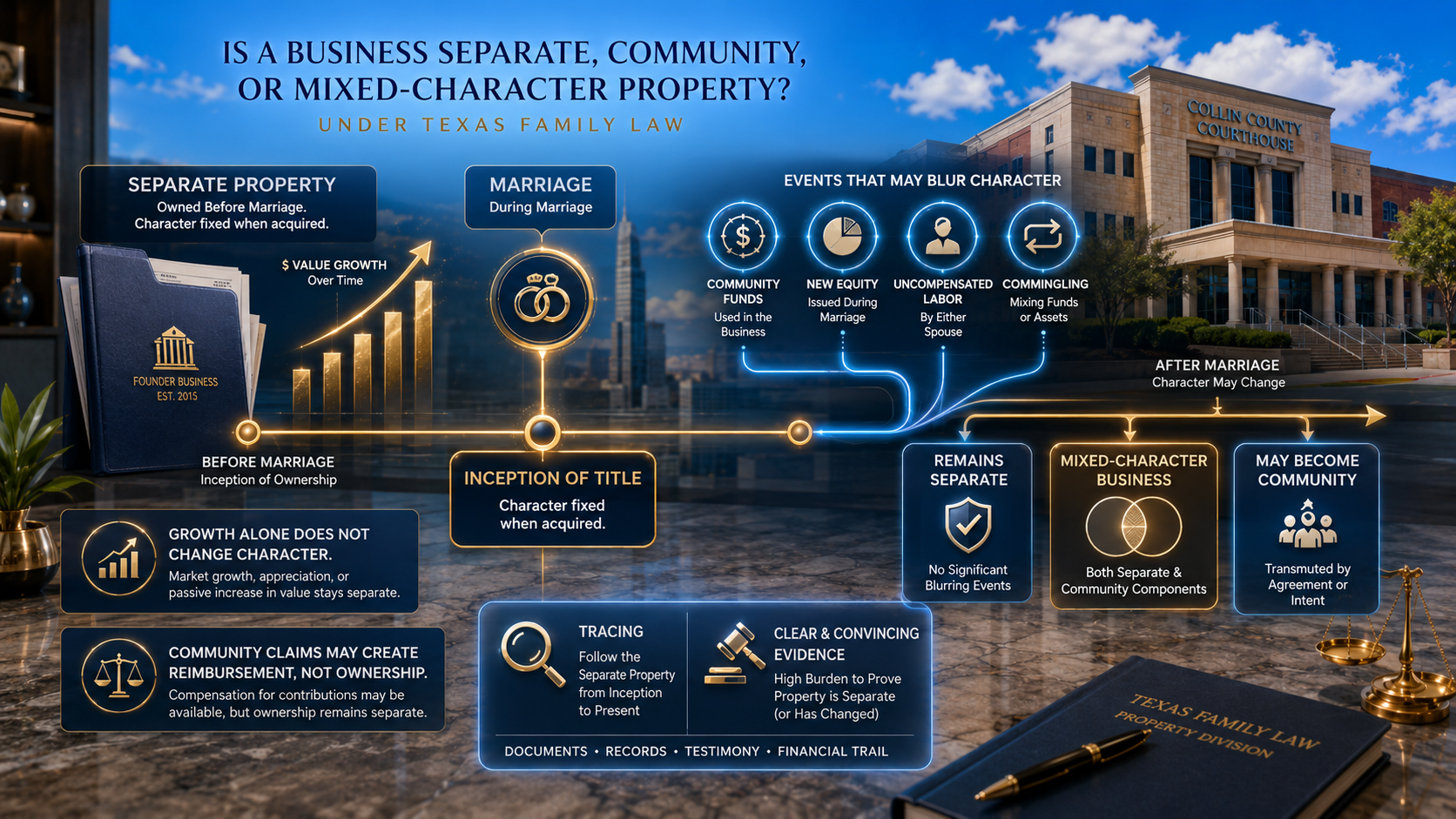
Texas characterizes property as of the moment it is acquired. If your ownership interest came into existence before marriage, it is separate property — and it keeps that character even as the business grows during the marriage.
The Inception-of-Title Rule
Texas law fixes the character of an asset at the moment a party acquires a right to it — its inception of title. If you formed your company or acquired your ownership interest before marriage, that interest is separate property. Critically, the later growth in its value does not change that character. A business worth fifty thousand dollars at marriage and fifty million at divorce is still, as to the underlying ownership interest, separate property. Texas does not divide the appreciation of separate property the way some other states divide marital growth.
This is the single most important and most misunderstood rule in business characterization. It is also why the community’s claims, when they exist, take the form of reimbursement rather than ownership — the topic of a related spoke below.
The Community-Property Presumption and the Burden to Overcome It
Texas presumes that all property possessed by either spouse during or on dissolution of marriage is community property. To establish that your business is separate, you carry the burden of proving its separate character by clear and convincing evidence — a higher standard than the everyday preponderance standard. Meeting it almost always requires tracing: documentary proof connecting the asset to a separate-property origin.
For a company formed before marriage with clean records, that proof is straightforward. For a company formed during the marriage, or one whose finances commingled with marital money over the years, tracing becomes the central battle of the case.
What Blurs the Line
A business that began as cleanly separate can acquire community characteristics — or generate community claims — through events during the marriage:
- Capital from community funds. If marital earnings were invested into the company, the community may have a reimbursement claim, and depending on structure, an ownership question can arise.
- Your uncompensated labor. Time, toil, and talent you spent growing the business for less than market pay generates a community reimbursement claim — see the Jensen claim.
- New equity acquired during marriage. Shares or units you bought or were granted during the marriage may be community property even if your original stake is separate, creating a mixed-character interest.
- Commingling. Running personal and business money through the same accounts, or mixing separate and community funds without records, can defeat tracing and expose the asset to the community presumption.
- Entity formed during marriage. If you created the company after marrying, even using separate funds, you must trace those funds to keep the interest separate.
Mixed-Character Businesses
Many founder businesses are not purely separate or purely community — they are both. A pre-marriage stake (separate) combined with additional equity acquired during marriage (community), or a separate-property company that absorbed community capital, produces a mixed-character asset. Sorting out the proportions, and then deciding how to divide or offset the community portion, is detailed work that runs through valuation and division. It is the reason characterization is never a yes/no question for a real operating business.
Why This Page Comes First
Characterization is the foundation. Until you know what is separate, what is community, and what is mixed, you cannot value the divisible interest, you cannot evaluate reimbursement claims, and you cannot plan a division. Everything else in a business owner’s divorce builds on the answers here.
Frequently Asked Questions
Not sure whether your business is separate, community, or mixed?
Characterization drives everything that follows. The sooner the records are gathered and traced, the stronger your position.
This page provides general information about Texas law and is not legal advice for your specific situation. Reading it does not create an attorney-client relationship.