
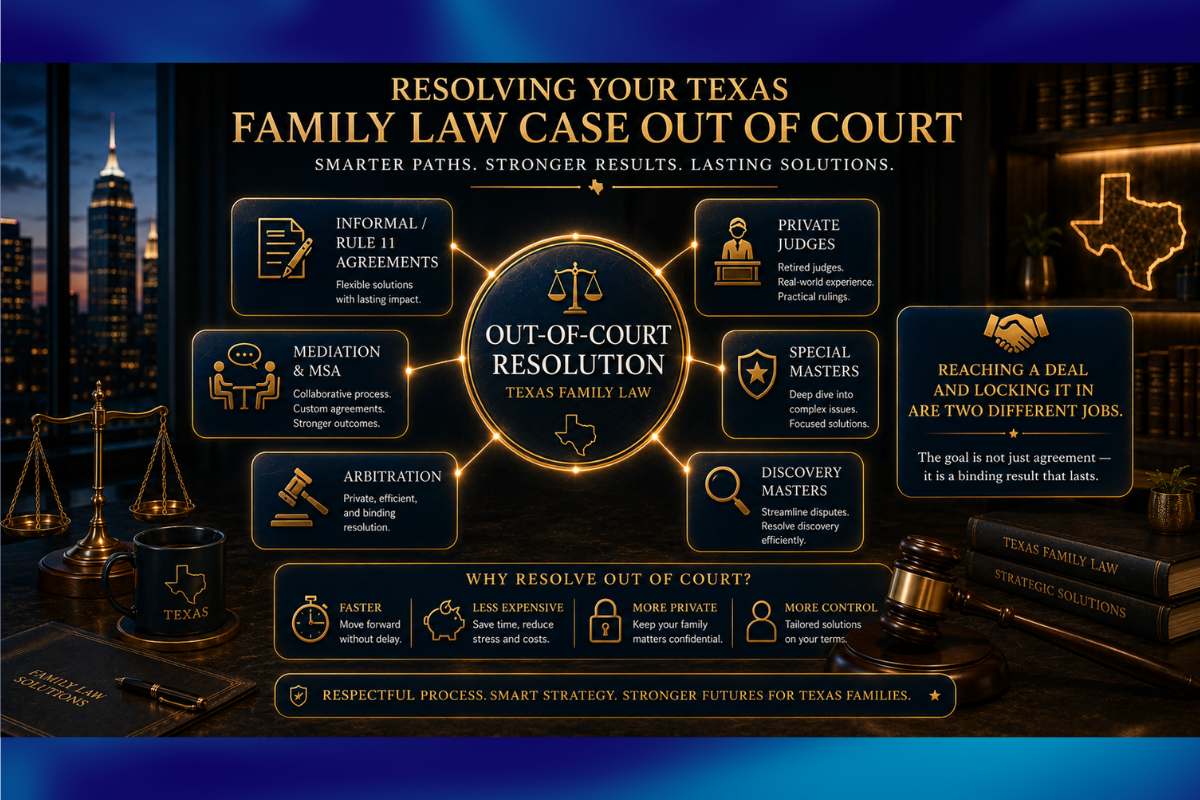
Resolving Your Texas Family Law Case Out of Court
Most Texas family law cases resolve without a final trial before the presiding judge, and that is usually a good thing. Out-of-court resolution tends to be faster, and is always less expensive, more private, and more within your control than handing your future to a crowded docket managed by the government. Texas law provides a whole toolkit for getting there, ranging from a simple written agreement between the lawyers all the way to appointing a private judge or arbitrator to decide the case. This guide walks through each tool, explains when it fits, and describes how a good lawyer uses it to your advantage. A recurring theme is worth stating up front: the goal is often not just to reach an agreement, but to lock it in so the other side cannot walk it back.
Reaching a deal and locking it in are two different jobs
An agreement your spouse can revoke tomorrow is worth far less than one the court has rendered as its judgment. Much of the strategy below is about closing that gap, turning a revocable agreement into something binding.
Why Resolve a Case Out of Court
Texas courts are busy, and family dockets in growing counties like Collin and Denton are busier every year. A contested final trial can be months out, costly to prepare, and unpredictable once you are in front of a judge who has limited time to absorb the nuances of your estate or your family. Resolving your case out of court lets you trade that uncertainty for a result you helped shape. The philosophy that guides good family law practice is simple: clients benefit enormously from a well-crafted agreement, and should pursue one wherever possible, but they should never fear going to trial, because the credible willingness to try the case is often what produces the favorable agreement.
The Settlement Tools
These tools help the parties reach and secure an agreement, arranged roughly from the least to the most formal:
- Informal and Rule 11 settlement agreements: written agreements between the parties, and the strategy of having the judge render on them so they become the court’s judgment rather than a revocable contract.
- Mediation and the mediated settlement agreement: the workhorse of family law settlement, and the uniquely binding statutory MSA that a party generally cannot revoke.
The Adjudication Tools
When some or all issues will not settle, these tools let a mutually chosen neutral decide them, outside the general docket:
- Private judges (special judges): a retired or former judge, chosen by the parties, hears the case under Chapter 151 of the Civil Practice and Remedies Code, with the verdict standing as the referring court’s own.
- Special masters (masters in chancery): under Rule 171, an expert neutral assists the court with complex issues and reports findings, by agreement or, in exceptional cases, by appointment.
- The master-as-mediator hybrid: one neutral who first tries to mediate disputes and, failing that, rules on them as special master, ideal for complex, multi-jurisdiction estates.
- Discovery masters: a practitioner who takes discovery disputes off the court’s plate and resolves them quickly, keeping the case moving.
- Arbitration: the parties agree to have a private arbitrator decide the case, with a strong pro-enforcement framework and a confidential, flexible process.
How These Fit With the Rest of Your Case
Out-of-court resolution is not a separate track from your divorce or custody matter; it is how most of those matters actually end. The agreements reached here determine your property division, your custody and possession arrangements, and support. That is exactly why the mechanics matter so much: a favorable agreement that is properly rendered and accurately reduced to a final judgment is the difference between peace and years of enforcement litigation. The pages in this cluster explain how to get there and how to make it stick.
Frequently Asked Questions
Resolving Your Case Out of Court in Texas – Related Articles
Arbitration in Texas Family Law
Discovery Masters in Texas Family Law
The Master-as-Mediator Hybrid in Texas Family Law
Special Masters and Masters in Chancery in Texas (Rule 171)
Private Judges and Special Judges in Texas (Chapter 151)
Mediation and Mediated Settlement Agreements in Texas
Informal and Rule 11 Settlement Agreements in Texas
Want to resolve your case efficiently and on your terms?
The right resolution tool depends on your case. Let’s talk through your situation and build a strategy that gets you a favorable, durable result.
This page provides general information about Texas law and is not legal advice for your specific situation. Reading it does not create an attorney-client relationship.