
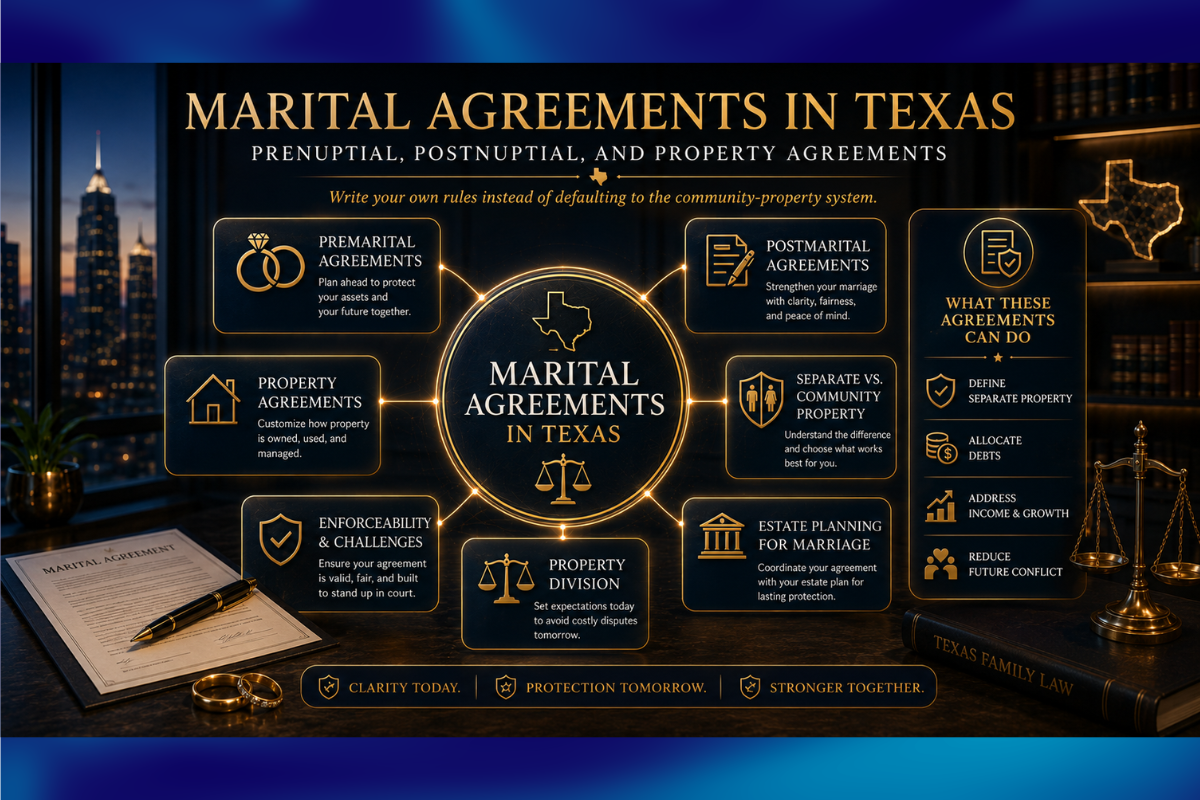
Marital Agreements in Texas: Prenuptial, Postnuptial, and Property Agreements
Texas is a community-property state, which means that without an agreement, the law decides how your property and debts are characterized and divided. A marital agreement lets you and your spouse, or future spouse, write your own rules instead. Done well, these agreements bring clarity and protection, whether you are entering a marriage with a business, separate property, children from a prior relationship, or simply a desire to know where you stand. This guide explains the kinds of agreements Texas recognizes, what they can and cannot do, and how to make one that holds up.
An agreement is estate planning for your marriage
A marital agreement is not a sign of distrust. It is a clear-eyed plan that protects both spouses, reduces conflict if the marriage ever ends, and lets you decide your own rules rather than defaulting to the community-property system.
Why Marital Agreements Exist
In Texas, property acquired during marriage is presumed to be community property, and separate property must be proven. Those default rules work for many couples, but not all. A marital agreement lets spouses opt out of or modify the defaults: defining what stays separate, how income and growth are treated, how debts are allocated, and what happens on divorce or death. The goal is certainty. Instead of leaving these questions to be fought over later, you settle them in advance, in writing, on your own terms.
Agreements Before Marriage
- Premarital (prenuptial) agreements: signed before the wedding, these set the property rules for the marriage from day one and are the most common form.
- Cohabitation and non-marital agreements: for unmarried partners who want to define property and financial expectations without marrying.
Agreements During Marriage
- Postmarital (postnuptial) agreements: entered after the wedding, to set or reset the property rules once the couple is already married.
- Partition and exchange agreements: convert existing or future community property into each spouse’s separate property.
- Agreements converting separate property to community: the reverse move, turning one spouse’s separate property into community property.
What These Agreements Can and Cannot Do
- Scope and limits: what a Texas agreement can control, and the firm boundaries, especially around child support and custody, that it cannot override.
- Enforceability and challenges: the voluntariness and disclosure rules that decide whether an agreement holds up, and how to sign one that does.
How Agreements Connect to Property Division
Marital agreements work by changing the property characterization that would otherwise apply, so they connect directly to how Texas handles property division and the line between separate and community property. If a marriage does end, a valid agreement can simplify or even largely resolve the property side of a divorce, which is much of their value.
Frequently Asked Questions
Marital Agreements in Texas – Related Articles
Enforceability and How Texas Marital Agreements Are Challenged
What a Texas Marital Agreement Can and Cannot Do
Cohabitation and Non-Marital Agreements in Texas
Partition and Exchange Agreements in Texas
Agreements Converting Separate Property to Community in Texas
Postmarital (Postnuptial) Agreements in Texas
Premarital (Prenuptial) Agreements in Texas
Considering a marital agreement?
A well-drafted agreement protects both spouses and holds up when it matters. Let’s design one that fits your situation and your goals.
This page provides general information about Texas law and is not legal advice for your specific situation. Reading it does not create an attorney-client relationship.