
Conservatorship in Texas: Joint and Sole Managing Conservatorship Explained
Conservatorship is where every Texas custody case begins, and it is also where the most common misunderstanding lives. Conservatorship is about parental rights and duties, who gets to decide where the child goes to school, who consents to medical care, and who designates the child’s primary home. It is not the same as the schedule of time with the child. Understanding conservatorship first makes the rest of a custody case far easier to follow.
“Joint” is about rights, not a 50/50 calendar
Joint managing conservatorship means parents share decision-making rights and duties. It does not mean equal time, and one parent usually still designates the primary residence. The schedule is set separately, by the possession order.
Rights and Duties, Not Time
Conservatorship allocates the rights and duties of parenthood. These include the right to make decisions about education, the right to consent to medical, dental, and psychological treatment, the right to receive child support, and, critically, the right to designate the child’s primary residence. Some rights are held independently by each parent, some are shared and require agreement, and some are given exclusively to one parent. A custody order spells out, right by right, who holds what.
Joint Managing Conservatorship
Joint managing conservatorship, or JMC, is the arrangement Texas presumes is best, and it is what most cases produce. In a JMC, both parents share in the rights and duties, though not necessarily equally, and they are expected to confer on major decisions. The word “joint” leads many parents to assume it guarantees equal time, but that is not what it means. JMC describes the sharing of authority, while the actual schedule comes from the possession order. In many JMCs, one parent is still designated as the one who establishes the child’s primary residence–in fact, if the parents cannot agree to a geographic restriction on the child’s primary residence and ask the judge to make that decision, the judge must designate one parent has having the exclusive right to designate the child’s primary residence.
Sole Managing Conservatorship
Sole managing conservatorship, or SMC, gives one parent the exclusive right to make certain significant decisions for the child. It is the exception rather than the rule, appropriate where the other parent is absent, unfit, struggling with substance abuse, or where there is a history of family violence or neglect. When one parent is named sole managing conservator, the other is typically named possessory conservator, with defined rights and a possession schedule that may be more limited. Establishing the need for SMC requires real evidence; it is not granted simply because parents do not get along.
The Right to Designate the Primary Residence
Among all the rights, the exclusive right to designate the child’s primary residence is often the most contested, because it often determines where the child lives day to day and frequently which parent the child is with most–and, most critically, which parent will pay child support to the other parent. This right is usually paired with a geographic restriction limiting where the primary residence can be, so that the other parent’s access is protected. Disputes over this single right drive a large share of custody litigation, mostly because, in our experience, most “primary” battles are really battles over wanting to receive or not wanting to pay child support.
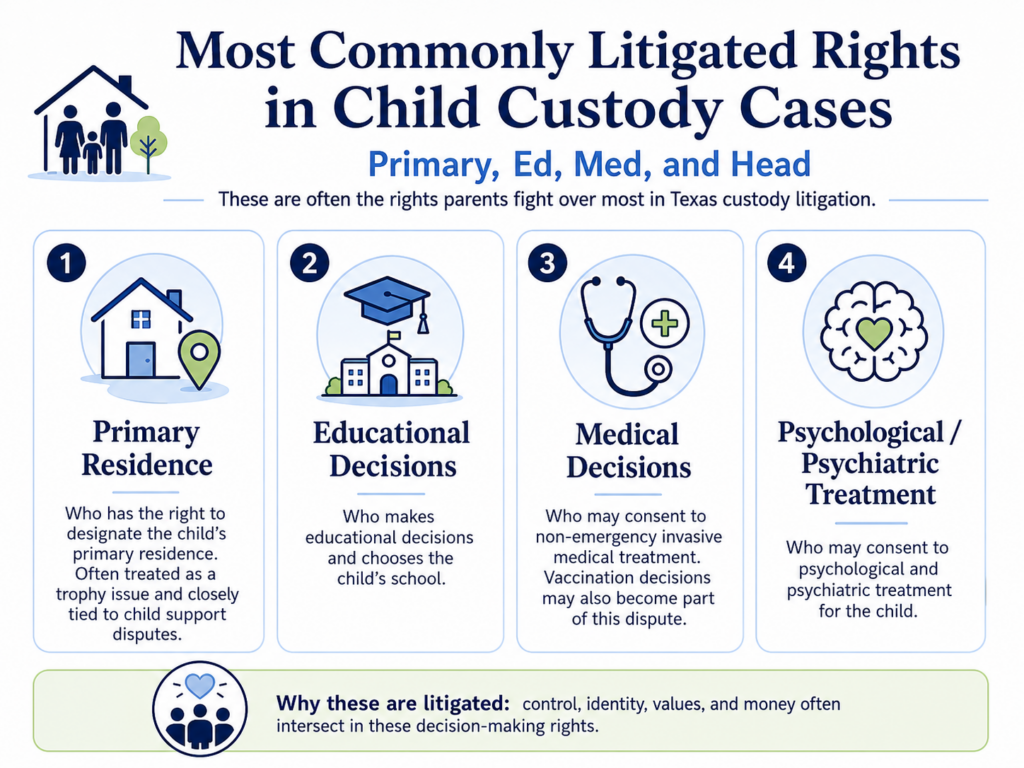
Most Commonly Litigated Rights
In our experience, the most commonly litigated rights are what we call “primary, ed, med, and head,” that is the right to designate the child’s primary residence, the right to make educational decisions and select the child’s school, the right to consent to non-emergency invasive medical treatment, and the right to consent to psychological and psychiatric treatment for the child. Within the right to consent to non-emergency invasive medical treatment is the debate over whether a vaccination constitutes an invasive procedure because different parents have different attitudes about vaccination. The right to designate the child’s primary residence is fought over as a “trophy” (“I’m the MAIN parent”–that’s not what that legal term means, but that’s how parents treat it) and as a proxy battle over who is going to pay child support.
When Safety Changes the Analysis
Texas applies a presumption favoring joint managing conservatorship, but that presumption can be rebutted, and a history of family violence rebuts it. Where there is credible evidence of abuse or violence, the court can decline JMC, name the protective parent as sole managing conservator, and impose restrictions, including supervised possession, on the other parent. The child’s physical and emotional safety is not a side issue; it sits at the center of the best-interest analysis that governs the entire case.
Frequently Asked Questions
Need to understand your rights as a parent?
Conservatorship decides who makes the decisions that shape your child’s life. Let’s make sure your rights are protected.
This page provides general information about Texas law and is not legal advice for your specific situation. Reading it does not create an attorney-client relationship.