
Possession Schedules and the Standard Possession Order in Texas
If conservatorship is about who decides, possession and access is about who has the child and when. This is the schedule, the actual calendar of overnights, weekends, holidays, and summers that governs daily life after a custody case. Texas provides a default schedule, the Standard Possession Order, but it is a floor and a framework, not a straitjacket. Understanding how the standard schedule works, and where it can flex, is what lets parents build an arrangement that fits their child.
The 100-mile line changes the whole schedule
Whether parents live within 100 miles of each other is the single biggest factor in the possession schedule. Inside that radius you get frequent, shorter periods; beyond it, the schedule shifts to longer but less frequent blocks built around travel.
The Standard Possession Order
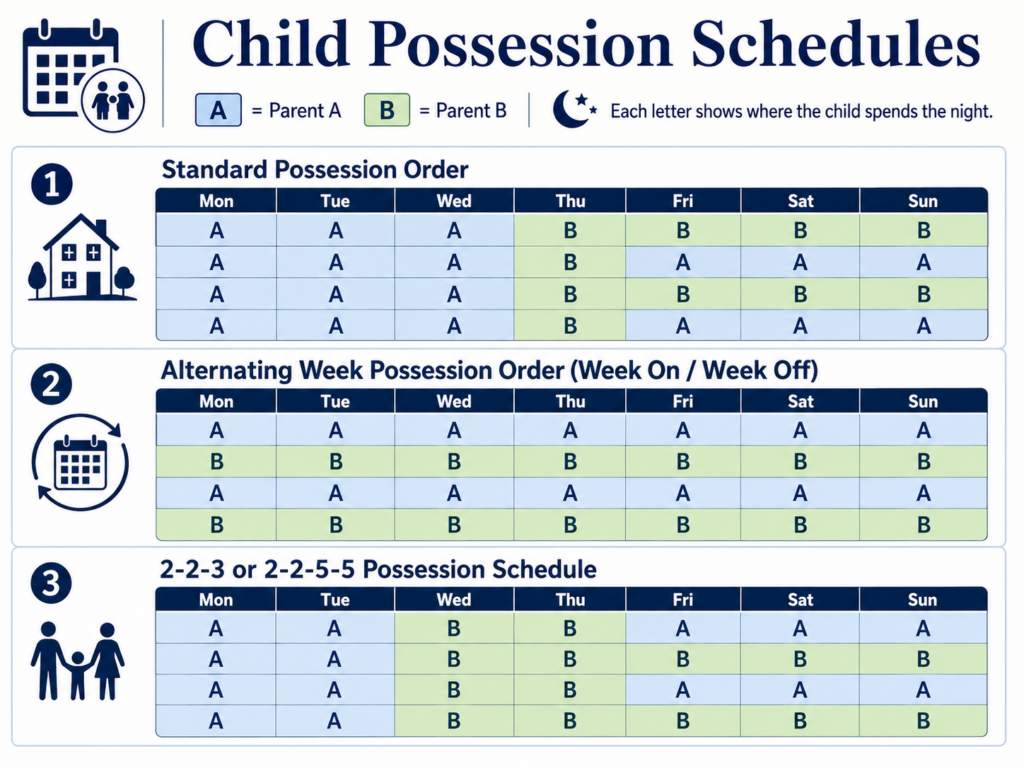
The Standard Possession Order, or SPO, is the default schedule the Texas Family Code provides, and it is presumed to be in the best interest of a child age three or older. In its familiar form, for parents living within 100 miles of each other, it gives the parent without the primary residence possession on the first, third, and fifth weekends of each month, a period of time on a designated weeknight during the school year, alternating major holidays, and an extended stretch in the summer. It is meant to be a reasonable baseline, not the ceiling of what a parent can have.
The Expanded SPO: More Time Within the Standard
Texas builds in an expanded version of the standard schedule that meaningfully increases time. By electing expanded periods, a parent can have weekend possession begin when school is dismissed on Friday and end when school resumes on Monday, and the weeknight visit can extend overnight. These elections convert daytime visits into overnights and add hours that add up across the year. In many cases the parent is entitled to make these elections, so it is worth understanding them before agreeing to the bare-bones version.
Equal and Near-Equal (50/50) Schedules
Equal or near-equal possession has become far more common in Texas, and several workable structures exist, such as week-on/week-off or 2-2-3 rotations. A 50/50 schedule is not automatic and is not right for every family: it depends on the parents living close enough to share a school, their ability to communicate and cooperate, and the temperament and needs of the child. Where those conditions are met and it serves the child’s best interest, an equal schedule is very achievable; where they are not, forcing one can do more harm than good.
When Parents Live More Than 100 Miles Apart
Once parents live more than 100 miles apart, the standard schedule changes shape. Frequent weekends become impractical, so the schedule trades frequency for duration: the distant parent may receive one weekend per month, a longer summer period, and most or all of certain holidays and school breaks. Because distance so dramatically reshapes access, any move that creates it is heavily scrutinized, which is the subject of the geographic restrictions and relocation page.
Custom Schedules and Safety-Based Limits
Parents are free to agree to a schedule that departs from the standard order when it better fits work, school, and the child’s activities, and courts will often adopt a sensible agreed schedule. At the other end, where a parent’s conduct raises safety concerns, the court can depart downward, ordering supervised possession, exchanges in protected settings, or other safeguards. The schedule is ultimately a best-interest tool, and the best-interest analysis is what justifies moving above or below the standard.
Frequently Asked Questions
Want the most time you can get with your kids?
The difference between a standard and expanded schedule is real time with your children. Let’s build a possession schedule that works for your family.
This page provides general information about Texas law and is not legal advice for your specific situation. Reading it does not create an attorney-client relationship.