
Fraud on the Community: Waste and Constructive Fraud Allegations
When a marriage is ending and one spouse controls the business and the checkbook, the temptation to move, hide, or quietly bleed value can be real. Texas law has a response. A spouse who improperly depletes the community estate can be held to account through claims of fraud on the community, and the court has tools to put the estate back where it should have been through reconstitution. This page explains the doctrine from both sides: For the spouse who fears it is happening, and for the operating spouse who needs to understand where the lines are.
The court can reconstitute the estate
If community assets were wrongfully depleted, Texas allows the estate to be valued as if the wasted assets still existed — and the wronged spouse can be awarded an appropriate share of that reconstituted estate.
Two Flavors: Actual and Constructive Fraud
Texas recognizes two related theories when community property is misused:
- Actual fraud involves intent — a spouse deliberately disposing of community assets to deprive the other of their benefit, often through concealment or deception.
- Constructive fraud does not require bad intent. It can arise when a spouse breaches the duty owed to the community by disposing of community property unfairly. Examples of constructive fraud include a gift or transfer that is unreasonable in light of the community’s interests, gambling losses, and fees paid to defense attorneys. The burden can shift to the spouse who made the transfer or expenditure to show it was fair.
Constructive fraud is the more common theory precisely because it does not require proving someone’s state of mind, only that a disposition of community property was unfair to the community.
What It Looks Like With a Business
In a business owner’s divorce, fraud-on-the-community concerns frequently center on how the operating spouse handles company money and opportunities:
- Unexplained or excessive distributions, salary changes, or transfers to friends, family, or new entities.
- Sweetheart deals such as selling assets or services below market to insiders.
- Suddenly suppressed earnings or deferred revenue timed to the divorce.
- Diverting business opportunities to a separate venture.
- Paying personal expenses through the business to disguise distributions.
Many of these overlap with conduct that temporary orders are designed to prevent, which is why behavior during the pendency of the case is scrutinized so closely.
The Remedy: Reconstituting the Estate
When fraud on the community is established, the court can calculate the value of the community estate as it would have existed but for the wrongful depletion — the reconstituted estate — and divide that larger estate. In practice this can mean awarding the wronged spouse a money judgment, a disproportionate share of the remaining assets, or other relief crafted to make the community whole. In our experience, this often shows up on asset division spreadsheets as an asset called “Reconstitution claim” that is awarded to the spouse who committed the fraud. This sounds counterintuitive until you consider that by awarding the fraudster a fake asset, real assets must be awarded to the wronged party to make up for the fraud. The point is that wasted value is not simply gone; it can be charged back against the spouse who caused the loss.
Example
Assume a husband is proven to have wrongfully depleted by community estate by $100,000 and that the remaining estate looks like this:
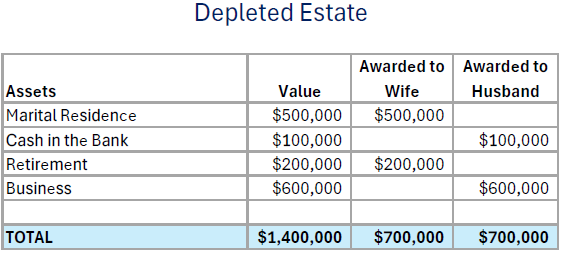
To reconstitute the community estate, we would add an asset called “Wife’s Reimbursement Claim”, value it at $100,000, and award it to husband. This signifies that the husband already received $100,000 from the community estate. This is called the “reconstituted estate.” Note that to get to a 50:50 division of the reconstituted estate, additional real assets must be awarded to the wife:
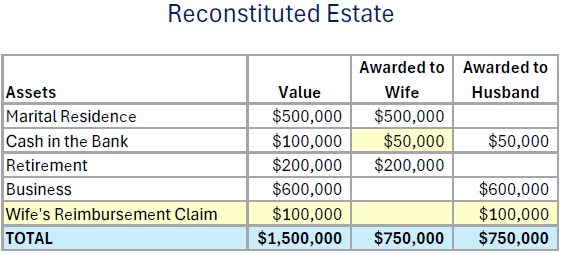
Why wasn’t wife awarded an additional $100,000 to compensate for the $100,000 that husband wrongfully spent? The theory is that half of the community estate was husband’s to spend as he wanted, as long as he didn’t deplete wife’s half. If you were not targeting a 50:50 division, you would award more “Cash in the Bank” or “Retirement” to wife to accomplish that. For example, if you were targeting a 53:47 split in wife’s favor, you might divide the reconstituted estate by awarding all of the “Cash in the Bank” to wife. If you were targeting a more generous division in favor of wife, you would have to award her a judgment, secured by the business, because the estate in this example has insufficient assets to accomplish that division without a judgment.
Proving It Takes Records and Experts
Like the reimbursement claims it often accompanies, a fraud-on-the-community claim is built on documentation such as bank and business records, accounting analysis, with those documents frequently examined by a forensic accountant who can trace where money went and identify what is missing or mispriced. Suspicion is not proof. The claim succeeds when the financial trail shows it. This is one more reason that discovery — and how business records are obtained and protected — sits at the center of these cases.
For the Operating Spouse
When running a business during divorce, run it normally, document your decisions, keep paying yourself and others consistently with past practice, and avoid unusual transactions without advice of counsel. Ordinary, well-documented business operations are not fraud. It is the deviations — the timing, the insiders, the unexplained — that create exposure.
Frequently Asked Questions
Money missing — or being accused of hiding it?
These claims are built on financial records and expert analysis. Whichever side you’re on, the time to get advice is now.
This page provides general information about Texas law and is not legal advice for your specific situation. Reading it does not create an attorney-client relationship.