
Child Support Guidelines in Texas: How Support Is Calculated
Child support in Texas runs on a guideline formula, which makes it look simple, but the formula’s inputs are where the real disputes happen. The percentages are fixed and familiar; the fights are about what counts as income, what the cap means for higher earners, and whether the guideline number actually fits the child. This page explains how the calculation works and where it bends.
The percentage is easy; the inputs are the fight
Everyone can recite “20 percent for one child.” The contested questions are what counts as net resources, how the cap applies to a high earner, and whether the guideline figure truly meets the child’s needs.
The Guideline Percentages
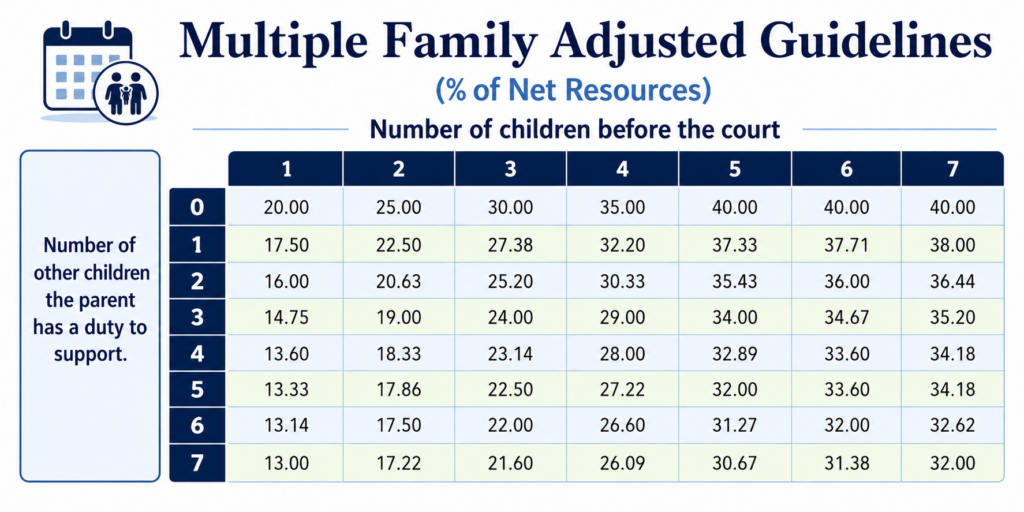
Texas sets presumptive child support as a percentage of the paying parent’s monthly net resources, scaled to the number of children before the court: 20 percent for one child, 25 percent for two, 30 percent for three, 35 percent for four, and 40 percent for five, with not less than that for more. These percentages are presumed to be reasonable, so in the typical case the calculation starts here. Adjustments apply when the paying parent also supports children in another household.
What “Net Resources” Means
The percentages apply to net resources, a defined term that is broader than a paycheck. It includes wages and salary, self-employment income, rental income, interest and dividends, and many other sources, from which the law subtracts specific items: federal income tax for a single person, Social Security taxes, union dues, and the cost of the child’s health and dental insurance, among others. Because the definition reaches many income sources but allows only certain deductions, accurately establishing net resources, especially for the self-employed or those with variable income, is frequently the heart of a support dispute.
The Cap and High-Income Cases
The guideline percentages apply to net resources only up to a statutory cap, which is adjusted for inflation over time. For a parent whose net resources exceed the cap, the guideline does not automatically reach the excess. Instead, additional support above the capped amount must be justified by the proven needs of the child. This turns high-income support cases into a different kind of dispute, one about what the child genuinely needs rather than a simple percentage, and it rewards careful presentation of the child’s actual circumstances.
Above-Guideline and Below-Guideline Support
The guideline figure is a presumption, not a ceiling or a floor. A court can order more or less when the evidence shows the guideline amount would not be in the child’s best interest, weighing factors such as the child’s specific needs, each parent’s resources, childcare costs, and the actual possession schedule, including whether the parents share time more equally than the standard arrangement assumes. Deviations require evidence and findings; they are available but not automatic.
Medical and Dental Support
Separate from base support, Texas orders for the child’s medical and dental support, typically by requiring a parent to provide health and dental insurance or to contribute toward its cost, along with the allocation of uninsured medical expenses. These obligations are ordered in addition to the percentage-based support, so the total a parent pays reflects both the base amount and the child’s healthcare coverage.
Support Can Be Modified
Child support is not frozen for all time. When circumstances change significantly, support can be revisited and adjusted, a process covered on the modifications page. And when support is established as part of a divorce, it is set alongside the rest of the case described in the divorce guide.
Frequently Asked Questions
Questions about how much support is right?
Getting net resources and the needs analysis right can change the number substantially. Let’s make sure your child support is calculated correctly.
This page provides general information about Texas law and is not legal advice for your specific situation. Reading it does not create an attorney-client relationship.